Using Song Cards to Keep Young Music Students Engaged
Getting younger students to sit still during longer songs can be a challenge. Of course we normally want lots of movement for our littles. But there are some songs that are valuable on their own with no movement or actions. And some of these can be longer songs.
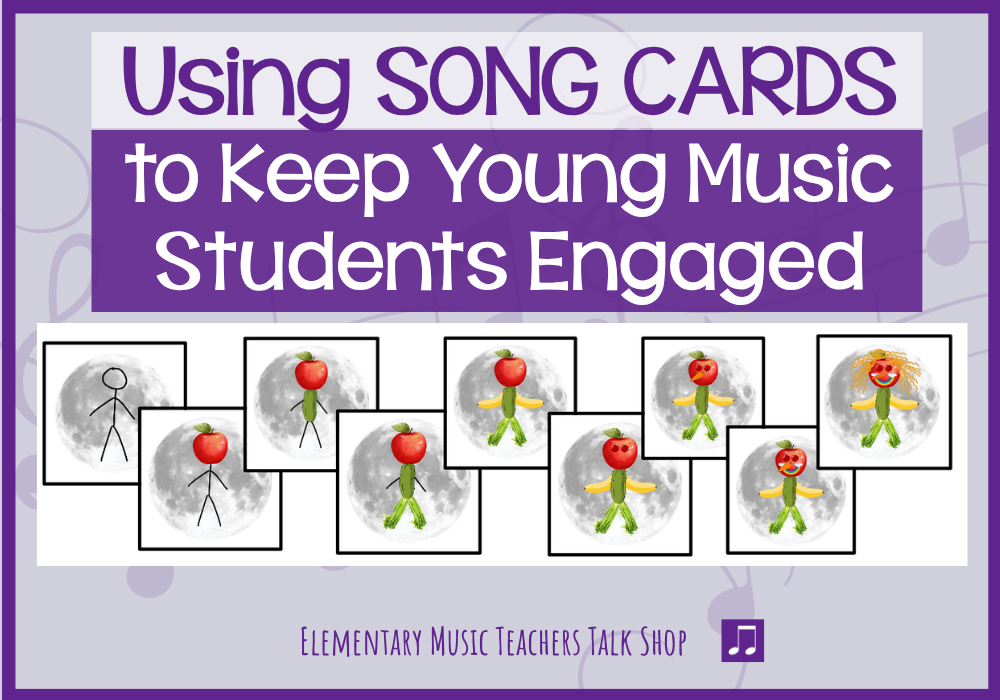
I specifically have a number of folk songs on the Jill Trinka/John Feierabend recordings that I discovered during Kodaly Training. However, with a number of verses, I realized that having song cards to assist student understanding and focus lead to more success in the classroom.
1. Song Cards Help Students Follow the Story
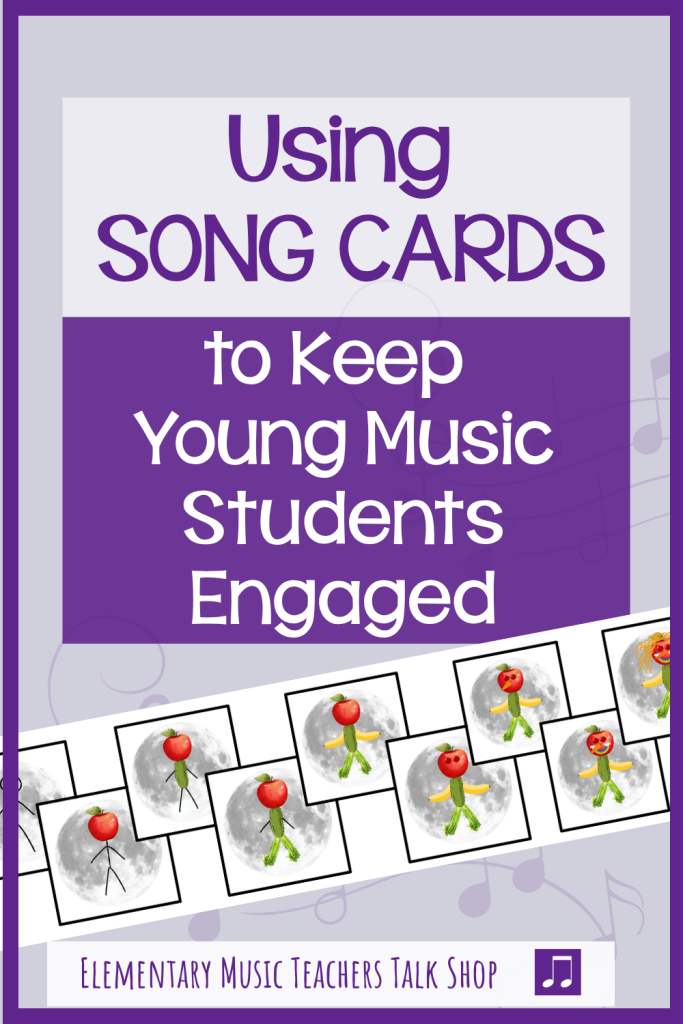
Many folk songs and children’s songs have a clear order. A character appears, an animal is added, etc. Adults may follow that easily, but young students often need help tracking what comes next. Song cards make the order visible.
2. Visuals Make Repeated Listening More Purposeful
Music teachers know that students often need to hear a song more than once before they can sing it confidently. The problem is that repeated listening can feel passive if students are just sitting and hearing the same song again.
Song cards give students a reason to listen carefully. Kids also anticipate which card is coming next which helps and when they see the visual it helps them remember the lyrics.
3. Song Cards Support Early Literacy Skills
Song cards are not just “cute visuals.” They can support several early learning skills that fit naturally into music class. After I introduce the song and use the visuals as a group a few times, I add the song cards to my rotation of center activities. (More on that below)
4. They Give the Teacher’s Voice a Break
As elementary music teachers, we use our voices constantly. Singing, modeling, giving directions, and managing transitions can add up quickly. One benefit of using quality recordings is that students can hear the song without the teacher having to sing every repetition. The teacher can still lead, guide, and interact, but the recording carries the vocal load.
5. Song Cards Work Well for Centers
Once students know the song, song cards can move from whole-group instruction into a center activity.
At a center, students can:
- put the cards in order
- match pieces to the correct cards
- retell the song quietly
- sing the song in their heads
- point to each card while listening
- work with a partner to rebuild the song sequence
This gives students an independent or small-group way to interact with the song after they have learned it with the teacher.
6. They Can Make Sub Plans Easier
If students already know the song, the substitute can show the cards while students listen and sing along. If the song is new, the substitute can still use the recording and cards as a guided listening activity. It is much easier than asking a substitute to teach a song from scratch.
7. A Simple Resource Option
If you want to try out Song Cards for all the reasons above, this set is perfect for you. All Jill Trinka recordings can be found on her YouTube channel.
The set includes six song card sets:
- Aiken Drum
- Over in the Meadow
- Down By the Bay
- There Was a Man
- Oh My! No More Pie
- I Had a Rooster
The cards are designed for PreK–2 music students and can be used for whole-group listening, sing-alongs, centers, and sub plans. Some of the activities also include cut-out pieces for more interactive center work.